A look at the city's past through its barely-remembered commercial signs.
Showing posts with label downtown. Show all posts
Sunday, September 30, 2012
Meta (Whirled Peas)
They've been working on renovating the long-vacant building on Hennepin that used to house Shinders and somehow that work has revealed a sort of meta-ghost. It's not particularly visually interesting, and I'm not sure whether it's really faded paint or the shadow of long-gone lettering. But if you look very closely, you can see that it says "Snyders."
When I was a kid, there was a Snyder's drug store in strip mall just up the road (ah, the pleasures of suburban living) and a Snyder Brother a little further down near Silver Lake Road and 694. Youthful me could not quite figure out how these stores could include the same surname but not be related to each other.
Now that the local drug store landscape seems to be made up only of CVS, Walgreens and a few independents (and, yes, Target and Walmart), I thought I'd let this "sign" be an inspiration to try to find out.
So the first thing to note is that the two stores may not have actually shared a surname, and instead I could be conflating homophones (yes, dear reader, I've been known to do that). The "brothers" store (from which I remember painted faces of happy looking pharmacists on the wall and in the print ads), might have contained some combination of "sch" or "ie", but I can't recall.
So let's start with Snyder's, whose demise was not so long ago. It traces its history to Max Snyder who sold cigars in downtown Minneapolis starting in 1928 (perhaps at this location?). The drugs came along in 1931, and by 1939 Snyder Drug was incorporated. Then a few decades passed, until a bankruptcy in 2001 that started the process of selling off locations to Walgreens and CVS.
Snyder Brothers has left less of a digital trail. This lawsuit suggests that I'm not wrong in remembering that it existed, and I even got the spelling right. This comment includes them in a list of chains that helped speed the demise of independent pharmacies. But that's about all I've got. At least my memory isn't totally faulty.
As for those drugstores of my youth, the Snyder Brothers, along with the strip mall that used to house it, is gone, replaced by an LA Fitness. The Snyder's was replaced by a Liquor Barrel. So at least you can get some kind of drug there.
Monday, August 20, 2012
Think Up Your Own Lame Double Entendre, Please
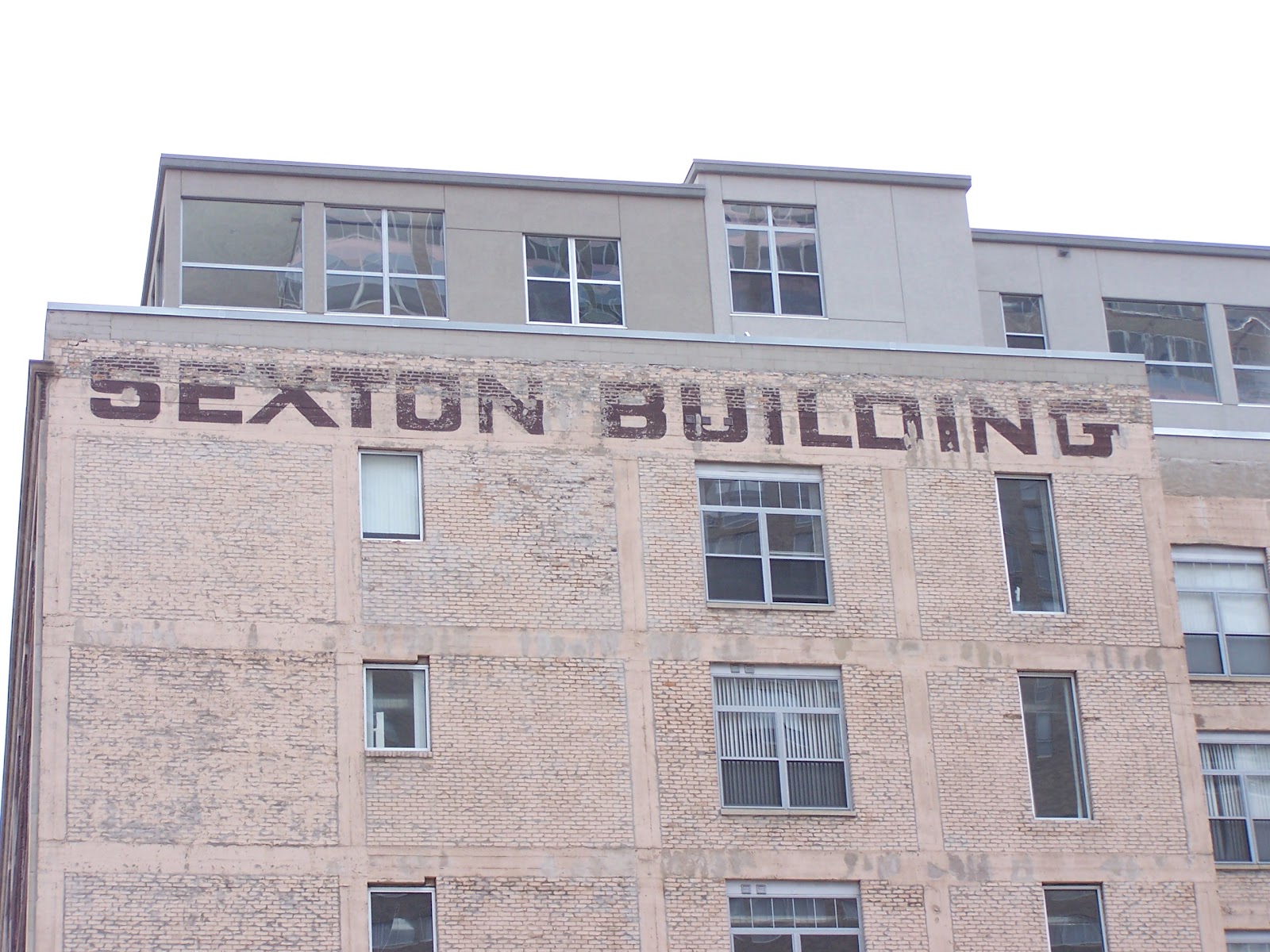
It's been awhile since we had a legit post around here (yes, I'm looking at you and you), so I went back into my photo archive and found a real honest-to-goodness, Minneapolis, paint-on-brick, from back in the day, aging-but-preserved ghost sign for you. You can thank me later.
The signs, for stores, factory, storage and warehouse space, may tell us something about the industrial history of the building, or it could just be Andrews Inc advertising for what they can offer nearby. But regardless, this was once a commercial building downtown, so it must still be in commercial use, right? No, of course not, silly. It's "lofts" now! What could be better?
Well, for the Sexton, perhaps lots of things could have been better. It seems to have had rather a rough conversion into hip, urban living space. Everyone involved seems to have sued each other, and residents were apparently promised a parking ramp (that's garage, if you don't speak Minnesotan) that never materialized. I could probably make this whole post out of the saga of the Sexton suits, but that seems snore-inducing, so I'm going to write about other stuff after this next picture:
So, as I often do, I've tried to find some of the actual history on the building, before its troubled condo conversion, but I've not found a lot. This guy seemed to promise to tell me something about it, but when you strip out the stuff from 2007 & 2008, he really just says it was an old warehouse. Yeah, we knew that.
Here's what I've got for actual history: a photo of the building looking sharp in 1924, another showing cobbled streets in front from the next year, and two from 1938 inside the building depicting what's described as a "hospital admissions project." At least these tell us something about the age of the building. Now. Are you ready for a tangent or two?
I knew you were. Okay. So having found little about the building itself, I got curious about its namesake. There must have been someone named Sexton around, right? It seems there were at least two fellows with that name who popped up right away in my searches. The first is a true Twin Cities old timer. Gus Sexton was lumberjack and logging camp operator along the St. Croix dating back to the 1870s who seemed to get his picture taken fairly regularly. He also seems to have given money for a pipe organ at St. Michael's church and owned property in Stillwater. Unfortunately, we all know the good citizen's of Minneapolis wouldn't allow a foreigner from the east side of the river to own a building on our glorious soil, so Gus probably isn't our guy.
A more likely suspect might be this fellow, Charles W. Sexton, pictured in 1919. It seems he was in the insurance game, if he's the guy mentioned in Best's Insurance Reports in 1922, but it also seems that he didn't live terribly long after that picture was taken, as Best's says he was deceased at the time of its report. William Gray Purcell seems to have written to his company to make a claim in 1915. He was apparently also a lawyer and his daughter seems to have married a lawyer, so maybe it's best not to speak of him anymore.
Sunday, February 26, 2012
Ghost Fails
I'm afraid, dear reader, that I've utterly failed you. That "glass and plow" building I just recently talked about? Yeah, well, I got it wrong. And now I'm compounding the error by giving you shot in which you can't read it anyway (but it's better than the blurry, poorly-lit shot of the whole sign I was originally going to use). The horror.
But it turns out that it wasn't "rch." It was "rgh," as in, "Pittsburgh" and as in "Pittsburgh Plate Glass Co." And the building with that name has a story to tell (and its own Facebook page). It's also called the "Northern Implement Company," thus explaining why it says "plow" on the side. I'm guessing PPG, short for Pittsburgh Plate Glass, is the successor company, which seems to be going strong. If so, it seems they no longer have local operations. The rather generically-named implement company is hard to investigate, as its main presence on the internet is pointers to this building.
The Historical Society has a bunch of interesting images. Here's the leaded glass department at the very beginning of the 20th Century. It doesn't look that much different a decade later. Finally, here's the outside of the building, and the cobblestone street, another decade after that, or another, or in the 1970s.
In news of other failures, I also can't believe that I told you the story of Wilbur Foshay without checking on what's available from the Historical Society. Not surprisingly, there are tons of pictures featuring this Twin Cities landmark. Go look at all of them. I'll just highlight a few: 1926 before there was a tower, excavation for the tower in 1927, the Foshay football team in 1928 with the Tower on their uniforms, the skyline during construction, brand-spanking new tower the same year, the dedication ceremony in 1929 featuring "scantily" clad women, and the auction of the building in 1930. And, of course, things would not be complete with out shots of Wilbur himself before the trouble, at the time of arraignment, at trial, and in Leavenworth prison working on a pardon while wearing a shirt, tie and cuff links.
Finally, in failures past, perhaps you remember the "Witt's" saga. It turns out that if I had walked through the alley behind it, I might have been able to make out this very dilapitated sign and known what I was looking at:
Labels:
downtown,
farm implements,
Food,
Glass Company,
update,
Witt's
Monday, February 20, 2012
They Could Make A Movie (Probably Called "Madison")
Try control your excitement, people. I know you never believed we'd get here. I know this blog has exceeded your expectations in every way, and now, well, now we've finally made it. That's right. We made it to post #100. Who knew there were that many signs to talk about?
So, as it's a nice, round number, we need a landmark. I've saved a good one. Okay, so it's not paint on brick, so maybe it doesn't fit exactly (hmm... maybe that says something about how we got here), but it is significant. It's the building that defined the Minneapolis skyline for years. If memory serves, it was long the tallest building in Minneapolis.
The Foshay has a bit of a dramatic history. It was completed in 1929 just a few months before the big stock market crash. It was the brainchild of Wilbur Foshay, who got rich buying utility companies and planned to move into a multi-level suite at the top of the building. The building opened to a lavish dedication and featured John Phillip Sousa conducting a specially-commissioned march. Each guest got a gold watch. Splendor abounded.
There was only one problem. Old Wilbur had a secret and, like Bernie Madoff, the onset of the Great Depression exposed him. His empire collapsed, he never moved into his new home, and the check he used to pay Sousa bounced. Wilbur was accused of running a Ponzi scheme and charged with fraud. His first trial ended in a mistrial after one juror, Genevieve Clark, held out for his innocence. He was convicted and sentenced to 15 years the second time around.
Only later was it discovered the Mrs. Clark's husband knew and had business dealings with Wilbur. Rather than face obstruction of justice charges, she and her family fled. The Clarks and their two children were later found dead from intentional carbon monoxide poisoning.
Things are a bit happier in the Foshay these days. The tower is taken up by the W Hotel and the two-story commercial space at the base houses Manny's, arguably the best steakhouse in town, and Key's, one of the better places for brunch and/or pie.
Even more fitting, the Foshay is framed here by the IDS Center, which replaced it as the tallest building in town in 1972 and the Well Fargo Center (originally, the Norwest Center, and before that the one with the weather ball), built to be technically just shorter than IDS out of Minnesota nice or something.
Saturday, February 11, 2012
Free Box of Steaks?
This is a tough one. It's clear enough that I can make out "Glass Co." and "Mirrors" but also "Plow." My guess is that strange pairing means more than one generation of sign, but let's see what we can find out.
Well, unfortunately, not much. There are a lot of glass companies out there, and "*rch" isn't really helping me. It could be Burch Glass Company, but they seem to be in Texas. Maybe we should ignore the glass and focus on the plow. Could it be Burch Manufacturing Company? Even though their web page mentions Minneapolis and farm equipment I don't understand, it doesn't look like they make plows and they are in Iowa.
So, well, that's all I've got. Maybe I'll have to go by a few more times and see if I can make it out. You can too, at 616 3rd St.
Update here.
Wednesday, October 26, 2011
To The Moon?
If you can read this one, on the side of 708 3rd St., you have better eyesight than I. But lo!, I have a hint for you:
We have some pretty cool-looking stone work, providing a longer-lasting, readable reminder for what the side used to say in paint. And if that's not cool enough for you, check out the front entryway:
So, all this screams, "hey, there used to be a lot of money in this business" to me. It's part of my my agricultural series, and a reminder of how this region made its mark (well, its second mark) off the region's farms.Emerson Newton, of Batavia, IL, as you can see, built this building in 1904, and, along with its neighbor (coming soon), is on the national register of historic places. Unfortunately, I've got a lot more on the building than on the company.
The historical society has a number of old images, from 1906, 1974 (with a United Warehouse painted on the side, oddly enough), and 1966, with an Allis-Chalmers sign visible on the side. It's not particularly relevant, but it has renewed significance for me because grandfather used to have a farm implement business in Clear Lake, WI. He died years ago, but I learned just last week, at his brother's funeral (just a few days short of 99), he sold Allis Chalmers machinery. So, basically, this means that these guys are sort of the competition, and, therefore, sort of evil.
Sunday, October 23, 2011
Close Personal Friends
It's post #80, which means I need a landmark, but I'm not sure I've got anything that qualifies. Nonetheless, I'll stretch a little (like the Vikings picking Christian Ponder with the twelfth pick), and use the authentic 1940s styled signs of Murray's. It kind of looks like something from 2005 that is trying for an old-fashioned look, but this is the real deal. I've never been, and I try not to eat red meat, but this is a place I have been hearing about since I was a little kid. Every Sunday morning I'd wake up to my dad listening to WCCO's Sports Huddle with Sidd and Dave, which has been bestowing Murray's silver butterknife steaks on guests for as long as I can remember. And all of a sudden I'm hungry.
Friday, October 21, 2011
Presumably Not Hand-Stolen In Stepney
The Vikings stadium saga is in the news again, so let's head back to the Metrodome neighborhood. This one is in the immediate vicinity of the hide and pelt dealer and the roller company. It looks to me like there are multiple layers of signs here, but they are rather hard to make out.Most legible to me is "Jones Purchasing Agency" at the top of the sign. The Downtown Journal, having beaten me to the ghost hunting punch by more than a few years, mentions this particular sign but doesn't give any history. Sadly, I've not got too much else either, but the intervening years mean I get to take advantage of Google Books. And the company whose stated mission is to organize all the world's information has something for me. It seems that city records show that the agency proposed to provide a cement mixer to the city in Feb., 1911. So I guess they sold stuff. Who knew?
As long as I can remember, this has been a store selling sports souvenirs. I've never been in, but I'd always wondered how much business they actually get. Do people really cross the street from the dome to pick up a t-shirt? I guess I'm just not the type who buys a lots of commemorative crap...er.. I mean gear.
Explanation of the title here.
Wednesday, August 17, 2011
Perfect Harmony
Coke's "It's the real thing" slogan seemed familiar to me, so I was surprised that it can apparently be dated fairly specifically to 1969, leading into the famous "I'd like to buy the world a Coke" ad and song. I would have thought that such a famous slogan would lead to an abundance of online trivia, so I was a little surprised when I didn't get much beyond wikipedia and that image searching lead me pretty directly to two Flickr entries for this very sign. It's on Washington Ave. N. near Broadway.My Google image search also turned up this, which I had to use because it features "Buddy Christ" from Kevin Smith's Dogma. I can't tell for sure, but while the site seems sincere, I would guess that the author knew the source of this image. But it's more fun to think that he wasn't in on the joke.
Sunday, August 7, 2011
There's No Crying In Roller Derby
Buildings' uses changes over time, and so do their signs. Right around the corner from the one for the gruesome collectors of animal bits, on the same building, we have Bingham Rollers. That's right, the famous champion of the 1920s and all time roller-derby great, Gloria Bingham, and her rag-tag band of bone-crushing compatriots used to have their offices here, conveniently next door to the Metrodome.Either that or they used to sell rubber-coated rollers (sounds kinda naughty, right?) here. I'm guessing about the "sell" part because it isn't a very big building, so it doesn't really seem like a manufacturing facility. I think this company was Samuel Bingham Rollers, which had a 175 year history before being acquired by Finzer Roller in 2004. Or maybe it was just paid advertising. Unfortunately, the folks who wrote the press release really weren't interested in telling us much about Bingham, nor does it seem likely that they had antitrust counsel involved.
You can see both this one and Mack, May Co. on Flickr.
Thursday, August 4, 2011
Better Get Jethro's Favorite Recipe
If you look closely, you can tell that it says, "Mack, May & Co." on top, and "Hides, Pelts" and other illegible things below. Thanks to Fins, Feather and Fur, the official bulletin of the Minnesota Department of Conservation, from April of 1928, we know that these folks apparently wanted you to send them your pelts, because, after all, they specialize in Muskrat! Never fear, though, they also dealt in wool, "in the grease." I don't know what that means, but let's just agree that it doesn't sound appealing. This time I'll leave the lame jokes to others. The sign's on the back of 900 S. 3rd St.
Monday, July 25, 2011
Poppin' Fresh!
Completing our survey of Falls-adjacent flour mills, it's time for Pillsbury. Perhaps the most famous of the local milling names (thanks to the blandness of General Mills), the "A" mill has been in the news fairly recently after being named as one of the most endangered historic places. The mill was completed in 1881 and was the largest flour mill in the world for 40 years. It stopped operating in 2003 and has since been through the redevelopment wringer. Unlike the Washburn A Mill, this one never exploded, although its design, by an architect rather than an engineer, had trouble standing up to the vibrations produced by its massive machinery, leaving the outer walls of the original mill building bowed out by 22 inches at the top.
I took several pictures I thought were worth posting, but once I got a shot with the horse-drawn carriage out front, how couldn't I put it up top? It's vaguely reminiscent of the horse drawn carts in front of the mill in this 1884 postcard.
Not surprisingly, there are many old images available from the Historical Society. This one, showing a train preparing to leave from the center of the complex, makes me think that someone should do a comparison showing what things look like today. Hmm. Perhaps I have a new project idea.
Not surprisingly, there are many old images available from the Historical Society. This one, showing a train preparing to leave from the center of the complex, makes me think that someone should do a comparison showing what things look like today. Hmm. Perhaps I have a new project idea.Finally, I'd highlight this one, from around the turn of the 20th century, showing a smaller mill complex as well as the water flowing on the riverbank below the mill. If I was more familiar with mill terminology, I could probably describe it more accurately, but I'd bet the water there has already been through the waterwheels.
Sunday, July 24, 2011
Made Out Of Tungsten?
It's time to circle back and pick up a sign we skipped over from one of my earlier hunts. I'm going to keep is short and sweet, because the Edison Building is the same as the Lumber Exchange. Somebody writing for wikipedia seems to think its "now know as" Edison, but I don't think that's even remotely right. It's the Lumber Exchange, and if you happen to look at it from the right angle you might see there's a sign that says Edison on the back.
Monday, July 11, 2011
Such A Lovely Place
We're back in my neighborhood for the Continental Hotel. Built in 1910, and originally called the Ogden Apartment Hotel, it's on the national register of historic places. It was originally middle class housing, of a type popular with single men and women, that differed from a typical apartment by the lack of kitchen. It's name was changed in 1948, perhaps after the original owner, James Ogden was no longer in the picture.
Messrs. Norton & Peel snapped it at least twice, perhaps for this postcard from the 1950s. You can commemorate Gertrude's stay in 1968 by buying a used (okay "vintage") copy here. In addition to enjoying her note to Ann of Racine, you can read the back of the card and learn that it billed itself as fireproof (probably means I'll find photos of a fire somewhere) and at the time offered daily and weekly rates. The daily rates were apparently no longer available by the time the famous photographer and filmmaker Robert Frank tried to stop in.
Today it's transitional housing for 70 formerly homeless individuals. It's the last remaining single room residential hotel in Minneapolis.
Thursday, July 7, 2011
Dedicated Followers of Fashion
I started to put this one up the other day, so I had to double-check that that I didn't actually post it. I'm not sure why I like this particular shot so much, except that I like the parallel lines of the sign for Nate's Clothing and the street sign. So, yeah, that's me pretending to be arty.Nate's is no longer operating from this location, but apparently was downtown for 92 years before moving on out to the suburbs in 2008. At the time, the space was to be converted to offices (what else), but I'm not sure what's there now. A Flickr user got this cool shot of the old sign out front. I don't recall seeing it, so I'm betting its no longer there.
The building, at 401 1st Ave. N., is apparently also known as the Manufacturers Building, and dates to about 1910.
Thursday, June 30, 2011
Fromagerie
I was going to try to make some sort of lame joke about not understanding what "For Rentals" means, but couldn't pull it off (yeah, I'm a dweeb). But if you look closer, underneath is a sign for Norton & Peel Commercial Photography, which is perhaps a little of what the kids these days call "meta" as these gentlemen are responsible for many of the Historical Society photos I've linked too. Apparently after disentangling himself from Ralph Kramdon's various escapades old Norton hooked up with Norman Vincent Peel to start taking photos (phew, knew I could work in a lame "joke" somewhere).The real Messrs. Norton & Peel operated their photography business at this location, from 1925 to 1965, taking more than 300,000 pictures, mostly of the local area, during that time. According to Peel's obituary, he "created the face of General Mill's original Betty Crocker."
The studio was on the second floor at 1004 Marquette Avenue, and the sign is right next to the one for Dahl's Violin Shop.
Wednesday, June 29, 2011
Not The Tiny Sarcastic One
Continuing in what maybe used to be the music district (if there ever was such a thing), we have this sign for Dahl Violin Shop. It's still there, although it doesn't seem to have a webpage. That's fitting for a store that is upstairs in an ancient building downtown. I don't know if it qualifies for "cool old building" architecturally, but it's an interesting block, right next to where the Nicollet was supposed to be. One internet commentator says Matthias Dahl was a famous Finnish violin maker, and apparently he made shoes in the old country before focusing on violins in Minneapolis in 1912. What a fascinating life story.Looks Better Than Bolero
Perhaps it's not fair to state it this way, but this one seems to be another victim of the planned Nicollet condos. It's Maurice Ravel's "Gaspard de la Nuit" on the side of what used to be the downtown headquarters of Schmitt Music. The company dates to 1896, although this mural was painted in the 1970s. Today the building is an apparently empty sales office for the condos, but I remember going to the old store with my music-teacher parents when I was a kid. In my child's memory it was maze-like and chocked full of sheet music, instruments and accessories.These days you need a memory that stretches back a few years to know what used to be here at 88 S. 10th St.
Tuesday, June 28, 2011
Flour Power
We're back to the mill district, with the preserved Gold Medal Flour sign that's a landmark on the riverfront. Above it's framed with the old mills and the Mill City Museum, and below with the "new" Guthrie Theater. We've already covered nearby Northwestern mills, and I'm sure the Pillsbury A mill will be in our future, but this time we feature signage for the still-available product from General Mills. The site is the Washburn A mill, which dates to the 1870s and was the largest in the world upon its completion. In 1878 an explosion rocked the mill, killing several people and reducing the city's milling capacity by a third. Not to be deterred by the deaths of 18, the mill was rebuilt and back up and running again by 1880.As you would expect, the historical society has a few good shots of the days when the mill was running as well.
Friday, June 24, 2011
Fly, Fly Away
Okay, this one isn't a commercial sign, but it's still kind of a ghost in its own way. It's on the back of the building that used to house the downtown Key's and, if I recall, the Scientologists, but has been empty of the last few years as The Nicollet (watch out for sound) was supposed to be built on top of it. That project was a go during the housing boom, but I'm not sure where it stands now. It's had issues. Had it been built, it was to have been the tallest residential building in the Midwest outside Chicago.I'm assuming that this is meant as public art, although it's really in a back alley. The lower left hand corner has two names, Benn Schanman and Jenn Spurgin, and a date, 4-78. Unfortunately I haven't been able to find who they are or why they painted this image of birds in flight over the Mississippi. Perhaps it's related to the rather cool sculpture and fountain on the Mall. If not, I'm fairly sure this "graffiti" on the boarded up windows on the front of the building is meant to reference it:
Subscribe to:
Posts (Atom)