Just a very quick update to note that the blog was featured on Fox 9 News.
Thursday, September 14, 2023


Monday, May 9, 2022
Just Quick Checkup

Hello? Is this thing on? So, it's been rather awhile. It seems that the Star Tribune linked to this humble blog, because someone is publishing a book of Twin Cities ghost signs (go buy the book). I'd basically gone inactive here, having mostly run out of material and having others things (i.e., kid) to occupy my time. But since a bunch of extra people have stopped by, I thought I'd dust off one of the few unpublished photos sitting on my camera roll (assuming I can remember how this thing works).
This one is pretty self-explanatory, for a family medicine clinic that presumably used to be in this building (at least part of which is currently available for rent) on Chicago Avenue just north of 53rd Street. Since we decamped from Downtown to south of the creek, I've walked by this one many times without posting it here. In part because I figured "Nokomis Clinic Ltd" isn't going to turn up much in an internet search. I figured correctly. Not even the phone number turns up a useful lead. I even did a reporter-like thing and tried to call it!
About all I've got to say is to wonder whether that hole in the wall replaced the expected "is" or whether the doc here got a little create and named it Nokomo or Nokoman or something. No, I don't know why anyone would do that either.
Anyway, it will hopefully not be another five years before the next post, but I will also need to find some more old industrial/commercial areas to explore.
Monday, June 19, 2017
Foreign Lands: Half A Ghost

As for the ghost part, it's another ad for Clicquot Club, a now-defunct soft drink brand we've covered before.
Friday, October 21, 2016
Life Is Like a Box of Sausages

I've seen this one before, but wasn't sure whether it was still an operating business (it must not have been as at one point this was an Asian seafood business). But having read that this building is to be the future home of a brewery or distillery with a rooftop patio, this time I knew it's a ghost and thus qualifies for inclusion here.
The sign is on the side of the former sausage factory at 427 Harrison St. NE, right up against the train tracks (train-people tell me this particular configuration of tracks is called a wye). Street View gave me a bit of initial confusion as the sign was not visible when last Google went by in 2014. Upon closer inspection, it seems there used to be siding on the end of the building that has now been removed.
Obviously, I hope they decide to keep the sign as they renovate the building. Unfortunately, it's painted over with a generic mural of wheat in the rendering included with that Business Journal article. Here's hoping the brewer/distiller has more appreciation for the character a sign like this offers than the architect.
As for the sausages, Ambassador is still an existing brand of Scandinavian-style hot dogs that's been around since 1932. Today it's part of Wimmers Meats, which itself is a division of Land O'Frost (and here I'd only head of Land O'Lakes and Land-O-Nod). Before all of that, however, Ambassador was associated with a 2014 inductee into the Minnesota Women Business Owners Hall of Fame (I did not know there was such a thing, but sounds cool to me).
Ethel Arnold began working at what was then called the Sanitary Sausage Company (mmmm... sanitary) in the 1930s, later moving into the front office as a bookkeeper. After the drowning death of her first husband, Ethel got remarried, this time to the company's founder. Once he too passed on, Ethel inherited the company, but it was in bleak shape. She used her experience in all aspects of the business to turn the company around and work out of its debt. She also renamed it. Maybe she thought sausages would sell better if they sounded fancy rather than just clean.
Ethel sold the company in 1991, ending the last remaining independently owned sausage company in the Upper Midwest. She died in 2000.
The Hennepin County Library's tumblr (I did not know it had one, apparently there are a lot of things I do not know) has a post on Ethel, including some old images of the inside and outside of the factory. Here's another shot of the sign from flickr.
Friday, September 23, 2016
Foreign Lands: Where's the Beef?

I had occasion to act like a real American this week and spend several hours driving a car (on World Car Free Day no less) and visit Real 'Merica (heck yeah!) in Chippewa Falls, Wisconsin (how's that for foreign, you guys? Would you like more parentheticals?).
One thing I love about visiting a new city is the opportunity to learn something, however small, about its history. Walking down Bridge Street in Chippewa Falls, you can see the boom that happened there around the turn of the 20th century. You can also see that lack of subsequent boom that's left those buildings in place, but a bit underused.
Which brings me to the sign above, which as you can see is nearly at the corner of Birch and Bridge streets (but for the convenient parking lot). At first I thought maybe it wasn't a "ghost" because, well, it's pretty darn clear, and there could still be a meat market there. But there isn't and I assumed that this one was touched up at some point as a bit of public art. There's a nearly identical, but far more faded, version on the other side of the building. Turns out, the one in our picture was recreated in 2002.
There's a thingie on the front of the building, up near the top (someone who knows something about architecture would probably know the word for that) that says "L. Bischel" and "1907." So it seems like a safe bet that the building was built in 1907 by a Bischel with the first initial "L" (Linus? Lionel? Leopold? Ludwig? Lucious? Lamont? Lucifer?).
Okay, it's actually Lorenz and it seems he moved to Chippewa Falls from Germany in 1863 and this building was actually the second location of his meat market on Bridge Street.
The power of Google informs us that that there were Brothers Bischel who were partners in a meat market here, but went their separate ways as reported in The National Provisioner on February 2, 1918, with John Bischel continuing in the business. I would have to guess that these brothers are Lorenz's sons.
The Wisconsin Historical Society has some older photos, perhaps from 1984, when the building housed Grothes Inc. electrical contracting. Today it houses Chippewa Falls Main Street, which seems to be an organization that tries to strengthen downtown Chippewa Falls. They also had a hand in getting this sign repainted, so they seem like they could be my kind of people.
So typically this blog is about hastily-researched and half-informed history (that's the bit you just read), but as I plan to cross post this on streets.mn, let me also ramble a bit about land use-y type stuff. Having spent almost very nearly an entire hour there, I can now proudly claim to be the world's foremost expert on Chippewa Falls, therefore, please stand by for my erudite critique of its urban planning.
Okay, so I'm not qualified for that in any way shape or form, but I'm going to offer some thoughts anyway. There were some nice banners along the streets (I'd bet the Main Street people had a hand in that) that said "bike," among other things, but I didn't see anyone on a bike. In fact, I think the only bikes I saw were on display in the sporting goods store. Someone had taken the time to paint "No Bikes" on a sidewalk though, so maybe I just missed the typical bike volume.
Nor did I see a bike facility of any type, leaving me wondering where the banner-hangers wanted people to ride. Granted, even though it was a weekday, the traffic volume wasn't so bad. I probably would have been willing to bike around downtown Chippewa Falls, but then again I'm someone who bikes kind of a lot. A less confident rider might find the Bay Street and Rushman Drive/High Street one-ways a bit daunting. They sure seemed like they'd be more pleasant as two-ways.
Meanwhile, directly across Bridge Street from Bischel's, there's a newish-looking Holiday, complete with giant parking lot and car wash, not unlike the one proposed for Northeast Minneapolis. Essentially in the middle of downtown. Just down the street from another gas station. And a few blocks across town from the large grocery store whose parking lot breaks the street grid. So, yeah, none of that is what an urbanist would suggest you do to make a vibrant downtown.
But I don't want to be too pessimistic. There were several cool things going on downtown too. The Korger's decorating store at Bridge and Central abuts the sidewalk on both sides, has street-level windows and, to my unprofessional eye, speaks nicely to the historic buildings of downtown, even though it was built in 2003. The Shoe Factory Apartments look like an cool adaptive re-use, that apparently hadn't happened yet when the Google Streetview last went by. I think this surface parking lot is now a hotel. They've also got a nice, newish roundabout at the bottom of Bridge Street. And, of course, I'm jealous of all of Wisconsin having 25 mph speed limits in town.
Anyway, I'm rambling toward a missing conclusion here, but perhaps the bottom line is that Chippewa Falls is totally worth an almost hour of your time. And probably more.
Sunday, February 14, 2016
Foreign Lands: How Much for that Tomato?

I had a few minutes to spare in the general vicinity of downtown St. Paul, so I went on by to check out the Penfield. Because at the frequency at which I visit downtown St. Paul, it's still something "new" over across the river. At the risk of going a little fanboy (young people still say that, right?), it was great and if I had reason to live abroad in foreign lands, it would be a great place to live. There's a beautiful grocery store right in the building and craft beer and good pizza right across the street.
Even better, there's a nearby ghost sign!
This sign, which reads, "Produce Exchange Bank" and offers residential, auto and real estate loans, is on the side of the Produce Exchange Building. The building apparently dates to 1915 and presumably was the home of the bank. Its seems there used to be a large market next door, and the building was turned into lofts in 2004.
A newspaper called the Chicago Packer reported in December of 1927 that the bank was temporarily closed by state authorities investigating whether its funds were used by the bank's Executive Vice President to dispose of stolen bonds. The bank was involved in a 1942 Minnesota Supreme Court usury case, the facts of which sound a little interesting (there shouldn't be a question whether you borrowed money from the bank or it's president personally), so its seems that the Chicago Packer's concern for the hardship on the city's produce traders should the bank never reopen was premature.
Santo Speranza was the bank president in 1942, and it seems the Speranza family continued with the bank for some time. Indeed, there's a scholarship at St. Kate's endowed by Mildred Speranza who was president of the bank from 1960-1980. According to the announcement for that stipend, it was a "family bank [that] helped Italian immigrants in the early 20th century secure funding to buy homes and start businesses" and she was one of the first women bank presidents.
Turns out there are interesting stories in the city's past. Who knew?
Here's another shot from flickr, Apparently you can live there. Here's the building sometime before 1920.
Sunday, January 31, 2016
Cigars In The City

Since we moved from our downtown condo to South Minneapolis last fall, and the weather took a turn for the worse after the new year, I find myself commuting on the 14 bus, from which I found a new ghost sign. With today's warmth, I got a chance to bike on by and snap a photo.
Unfortunately, I can't really make out what it's for. The word "Cigars" is legible in yellow toward the middle of the top, but that's about all I've got. My guess is that there are actually multiple layers of sign here, with the very top starting with one of the older black and white sign that are fairly common (for example, the Cameron Transfer and Storage signs). The cigar ad looks like the next layer and then who knows who tried to paint over what after that.
One thing you realize when you blog about these things is that weather and light conditions can make a big difference in how legible they are. I'll keep on pondering it from the bus window.
Sunday, June 8, 2014
In the Saddle Again

Okay, so it's not the greatest place to bike in the world. There was nary a bike lane, traffic was relatively swift moving and it turns out that it's pretty much up hill the whole way too. But at least traffic going north was relatively light, so I wasn't left fearing for my life.
More importantly, it led me to a spur of old railroad tracks that I hadn't inspected before. These places are always good for a ghost sign or two, and this one didn't disappoint. Okay, so it didn't really take much inspecting to come across the building shown above, which is pretty prominently on Lyndale right near North 44th Ave.
As you may be able to tell from the realty sign in the front yard (partially obscured by a small tree), the place seems to have been made available for reuse, so I don't think the Machine Specialties Manufacturing Company is still in operation at this location. Nonetheless, it has a Google place page for some reason, so maybe it was operating here not that long ago? Or maybe someone created the page because there's such a prominent sign?
I didn't think I'd learn much by searching for such a generic name, so I went in search of the realty listing to see if maybe they knew something about the history of this building. Apparently history is not a big selling point when you're trying to move tens of thousands of square feet of industrial space, but this offering document (pdf) does contain some interior pictures of the office space. They are both interesting in the sense that now you know what it looks like on the inside and uninteresting in the sense that they aren't very interesting at all. If you know what I mean.
But that document does give us a clue in that we now know that the property's seller is Zimmerschied, Inc., which leads us to its president, John Zimmerschied, telling the Business Journal back in 2004 that high steel prices and foreign competition were driving his small machine shop out of business. Apparently they made parts for equipment that is used to unload grain barges.
Saturday, May 11, 2013
A Different Kind of Ghost
This blog has always been more about what these old signs can tell us about local history. My favorite signs tell us about how the city used to work and what came before the modern skyscrapers and townhouses.
But by their nature, ghost signs come in limited supply. I've got more in my files, but I'm at the stage where interesting ones (or at least interesting ones that are still sufficiently legible to provide some clues) are running thin. I recently picked up Neal Karlen's Auggie's Secrets, which gave me a new idea for avenues into local history. I'm going to try to re-visit the places where Minnesota history happened. If I get lucky, there will be something of the past to see. More likely, you'll just have to be satisfied with my feeble re-telling of a tale from local history.
To start, let's look at a with a story relayed in Karlen's book, about this guy:

The gentleman in the middle (of this photo from the Minnesota Historical Society) is notorious Minneapolis organized crime figure Isadore Blumenfeld, aka Kid Cann. But this photo seems to be from the end of our story, apparently having been taken after he was acquitted.
On December 9, 1935, crusading journalist Walter Liggett was was gunned down in the alley behind his apartment at 1825 S. 2nd. Avenue. Here's an exciting photo of that alley today:

(Yes, that "exciting" was meant to be sarcastic).
Mrs. Liggett, who was present during the shooting, identified Cann as the man wielding the machine gun that day, and he was arrested, tried and acquitted of the slaying. But what's more interesting than one of several instances of Cann beating a charge is what led up to Mr. Liggett's killing. What's undisputed is that Liggett had recently written about potential ties between Cann's criminal organization and the administration of DFL Governor Floyd B. Olson. It's not hard to imagine how any number of individuals of shady repute might have been unhappy with airing this particular laundry, so the official line seems to be that dissatisfaction with being exposed was the motive.
But Karlen adds another interesting wrinkle. According to his book, Liggett wasn't exactly a crusader for good government. Instead, he allegedly made a living by selling hoods like Cann the opportunity not have their stories published in his paper. Cann had apparently declined the opportunity, perhaps in disbelief that anyone would publish such allegations against the sitting governor and the local crime boss, no matter how true. It seems that Liggett may have found out why Cann was so incredulous.
I'll leave you one last Cann-related image. This time the excitement is the former location of Cann's headquarters, a club called Flame:

Yup, it's gone now. UPDATE: Okay, it looks like I got the address wrong. The building is apparently still there, and that empty lot is not where it once was. Dang.
Here's the marquee from an undated Historical Society photo:

And here' the exterior of the building in a later incarnation in 1949 (also from the Historical Society):

But by their nature, ghost signs come in limited supply. I've got more in my files, but I'm at the stage where interesting ones (or at least interesting ones that are still sufficiently legible to provide some clues) are running thin. I recently picked up Neal Karlen's Auggie's Secrets, which gave me a new idea for avenues into local history. I'm going to try to re-visit the places where Minnesota history happened. If I get lucky, there will be something of the past to see. More likely, you'll just have to be satisfied with my feeble re-telling of a tale from local history.
To start, let's look at a with a story relayed in Karlen's book, about this guy:
The gentleman in the middle (of this photo from the Minnesota Historical Society) is notorious Minneapolis organized crime figure Isadore Blumenfeld, aka Kid Cann. But this photo seems to be from the end of our story, apparently having been taken after he was acquitted.
On December 9, 1935, crusading journalist Walter Liggett was was gunned down in the alley behind his apartment at 1825 S. 2nd. Avenue. Here's an exciting photo of that alley today:

(Yes, that "exciting" was meant to be sarcastic).
Mrs. Liggett, who was present during the shooting, identified Cann as the man wielding the machine gun that day, and he was arrested, tried and acquitted of the slaying. But what's more interesting than one of several instances of Cann beating a charge is what led up to Mr. Liggett's killing. What's undisputed is that Liggett had recently written about potential ties between Cann's criminal organization and the administration of DFL Governor Floyd B. Olson. It's not hard to imagine how any number of individuals of shady repute might have been unhappy with airing this particular laundry, so the official line seems to be that dissatisfaction with being exposed was the motive.
But Karlen adds another interesting wrinkle. According to his book, Liggett wasn't exactly a crusader for good government. Instead, he allegedly made a living by selling hoods like Cann the opportunity not have their stories published in his paper. Cann had apparently declined the opportunity, perhaps in disbelief that anyone would publish such allegations against the sitting governor and the local crime boss, no matter how true. It seems that Liggett may have found out why Cann was so incredulous.
I'll leave you one last Cann-related image. This time the excitement is the former location of Cann's headquarters, a club called Flame:

Yup, it's gone now. UPDATE: Okay, it looks like I got the address wrong. The building is apparently still there, and that empty lot is not where it once was. Dang.
Here's the marquee from an undated Historical Society photo:
And here' the exterior of the building in a later incarnation in 1949 (also from the Historical Society):
Sunday, April 7, 2013
Foreign Lands: A Pair of Mysteries

It's been awhile, but I had reason to travel all the way up to Bemidji, MN this weekend and came across a few news signs, so I figured I was overdue for a post. This two-for-one is the best of them.
Unfortunately there isn't much identifying information on the top sign. It's pretty clear that this building was once a hotel, which would have had a pretty good location near the center of the old downtown and near what looks to be the old passenger train depot, but aside from noting the modern rooms available by the day, week or month, it's hard to do any research without some type of ID. Strolling around the front of the building suggests that it is now the Summit Square Apartments. Perhaps on a day with better/different weather (it was snowing on April 6), it would be possible to make out more of the sign.
Meanwhile, you might find the one on the bottom a bit hard to read. "Cigar" should be legible, but you'll have to take my word for it that to the right of that the brand is advertised as "V-B." You'd think that it wouldn't be hard to find some information on the internet about a tobacco brand, but I'm not coming up with much. An outfit called Farmer's Tobacco seems to have a VB brand of cigarettes, but that company doesn't seem to have a history old enough to be the subject of this sign. I'm officially stumped.
Saturday, October 20, 2012
Foreign Lands: Booty Time!

Who's ready to party? Huh? Let's get your groove on. Move your body. Shake your booty and get them digits! It's a meat market, baby!
Okay, so it's not that kind of meat market. Or if it is, I'm confused why you would need your home freezer. I mean, if that's you and your honey's thing, who am I to judge? Just don't got all Dahmer or Bernie on me.
Here's a video of a guy saying this was a famous meat market in the 1970s. You can tell in that video that it's already closed as of a year ago. I had hopes that our friend would tell us more about it, but apparently to him the main item of note is that there were Vikings (no, not the plundering kind) who used to patronize the joint and leave their pictures behind.
You can also see in that video that there's a handwritten sign saying Jimmy has moved. I don't know if that's Jimmy up there with his face covered in brown spray paint, but apparently there was once a guy who worked here who was popular enough that someone thought folks might follow him.
Sunday, September 30, 2012
Meta (Whirled Peas)

They've been working on renovating the long-vacant building on Hennepin that used to house Shinders and somehow that work has revealed a sort of meta-ghost. It's not particularly visually interesting, and I'm not sure whether it's really faded paint or the shadow of long-gone lettering. But if you look very closely, you can see that it says "Snyders."
When I was a kid, there was a Snyder's drug store in strip mall just up the road (ah, the pleasures of suburban living) and a Snyder Brother a little further down near Silver Lake Road and 694. Youthful me could not quite figure out how these stores could include the same surname but not be related to each other.
Now that the local drug store landscape seems to be made up only of CVS, Walgreens and a few independents (and, yes, Target and Walmart), I thought I'd let this "sign" be an inspiration to try to find out.
So the first thing to note is that the two stores may not have actually shared a surname, and instead I could be conflating homophones (yes, dear reader, I've been known to do that). The "brothers" store (from which I remember painted faces of happy looking pharmacists on the wall and in the print ads), might have contained some combination of "sch" or "ie", but I can't recall.
So let's start with Snyder's, whose demise was not so long ago. It traces its history to Max Snyder who sold cigars in downtown Minneapolis starting in 1928 (perhaps at this location?). The drugs came along in 1931, and by 1939 Snyder Drug was incorporated. Then a few decades passed, until a bankruptcy in 2001 that started the process of selling off locations to Walgreens and CVS.
Snyder Brothers has left less of a digital trail. This lawsuit suggests that I'm not wrong in remembering that it existed, and I even got the spelling right. This comment includes them in a list of chains that helped speed the demise of independent pharmacies. But that's about all I've got. At least my memory isn't totally faulty.
As for those drugstores of my youth, the Snyder Brothers, along with the strip mall that used to house it, is gone, replaced by an LA Fitness. The Snyder's was replaced by a Liquor Barrel. So at least you can get some kind of drug there.
Monday, September 10, 2012
Foreign Lands: From The Association For Creative Building Names

This post #130, so I'm supposed to have something I can sort of call a landmark here. And I'm also not supposed to have signs from outside Minneapolis. But I'm having trouble reconciling those two rules right now, as I haven't got any good local landmark ideas at the moment, so I'm going to St. Paul.
The first Google result for this one calls it the "historic Minnesota building" so I'm going to hang my landmark hat on that. (The antitrust lawyer in me will just note without further comment that the first result is also a Google+ local site. Hey, look! Yelp! has a site too.)
You can watch a video of the building's "grand opening" from February of last year, which includes some historical information. But the building was built in 1929 and was built to be upscale offices, but soon became infested with lawyers. Keeping up with my architectural credentials, I can tell you that it's Art Deco, and was the first in that style in St. Paul. It's now mixed use, apartments (137 units with 10 reserved for formerly homeless residents), retail and office space. Way to go St. Paul!
Wikipedia will give you detailed description of the design. You can get more photos here and here.
Tuesday, September 4, 2012
Foreign Lands: Where's The Schnitzel?

We're back in St. Paul, where I found a gem of a place. Not surprisingly, it's near the railroad tracks, but it's also right on 7th St, but over on the east side. I'm not confident that we're going to find a lot in the history category, but it's a pretty cool building with great signs.
Today, it seemed to be low-end housing, although when I stopped there was a fancy SUV parked out front, which in my fantasy meant people planning to renovate. We'll have to see.
Anyway, as you can see, Charles E. Eschbach seemed to have a meat market here. It seems the Charles was born in 1890 and lived only until 1959. His son was also named Charles and is buried in Elmhurst Cemetery in St. Paul. It seems he might have furnished some meat to a family quarantined due to small pox in 1900, but that's about all I have.
So let's look for the flour. It seems the Dwight Flour was from Moorhead (speaking of traitorous foreign lands), so that probably explains why the place isn't still operating. Although this ad suggest maybe they were in Minneapolis too. So confusing. But one thing is clear. It was made from only Red River wheat.

Someone already got better pictures than mine (better light and more capable photographer, probably) and posted them to Flickr. It sees that some of the neighbors are gone.

Monday, September 3, 2012
Stop Me If You've Seen This One Before

Or better yet, don't. Because if you've been following along, you have, indeed, scene this one before. Or to be a bit more accurate, you've seen other parts of these "extensive works" before. This one is a little down the railroad tracks from the one you've seen before, but presumably they were all part of that same facility at some time.
The news here, if you can call it that, is that I'd swear the missing part of the sign says "Albany" and "New York," although I have to admit it could be bad memories of the bar exam influencing my intuition. I don't know why it would say that, of course, as it seems that they may have had offices in the Lumber Exchange downtown, but whatever. Maybe they just had a special affinity for the capitol of the Empire State.
Let's finish up by looking a up a bit (please shield you eyes from the sun):

Monday, August 20, 2012
Think Up Your Own Lame Double Entendre, Please

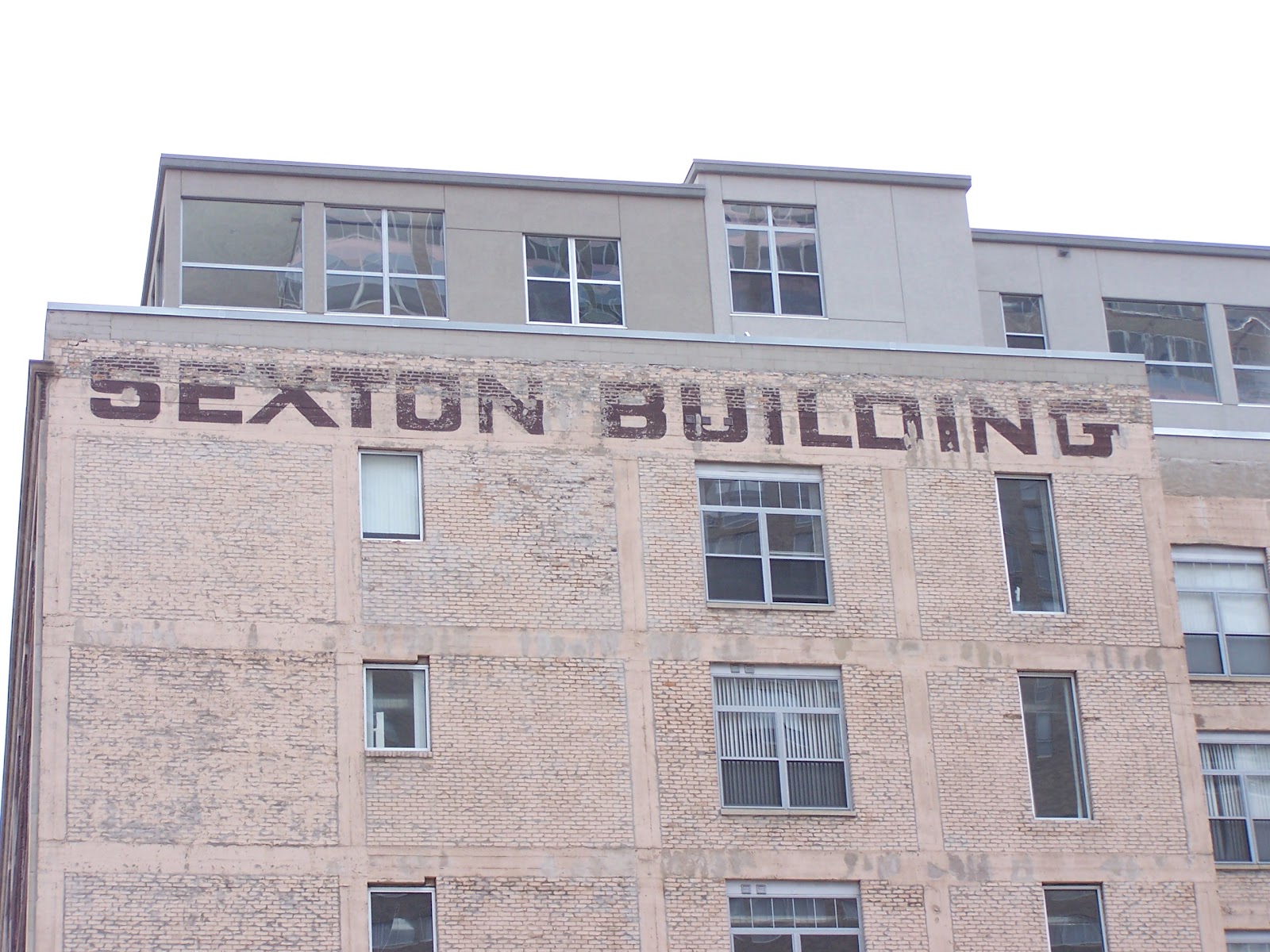
It's been awhile since we had a legit post around here (yes, I'm looking at you and you), so I went back into my photo archive and found a real honest-to-goodness, Minneapolis, paint-on-brick, from back in the day, aging-but-preserved ghost sign for you. You can thank me later.
The signs, for stores, factory, storage and warehouse space, may tell us something about the industrial history of the building, or it could just be Andrews Inc advertising for what they can offer nearby. But regardless, this was once a commercial building downtown, so it must still be in commercial use, right? No, of course not, silly. It's "lofts" now! What could be better?

Well, for the Sexton, perhaps lots of things could have been better. It seems to have had rather a rough conversion into hip, urban living space. Everyone involved seems to have sued each other, and residents were apparently promised a parking ramp (that's garage, if you don't speak Minnesotan) that never materialized. I could probably make this whole post out of the saga of the Sexton suits, but that seems snore-inducing, so I'm going to write about other stuff after this next picture:
So, as I often do, I've tried to find some of the actual history on the building, before its troubled condo conversion, but I've not found a lot. This guy seemed to promise to tell me something about it, but when you strip out the stuff from 2007 & 2008, he really just says it was an old warehouse. Yeah, we knew that.
Here's what I've got for actual history: a photo of the building looking sharp in 1924, another showing cobbled streets in front from the next year, and two from 1938 inside the building depicting what's described as a "hospital admissions project." At least these tell us something about the age of the building. Now. Are you ready for a tangent or two?
I knew you were. Okay. So having found little about the building itself, I got curious about its namesake. There must have been someone named Sexton around, right? It seems there were at least two fellows with that name who popped up right away in my searches. The first is a true Twin Cities old timer. Gus Sexton was lumberjack and logging camp operator along the St. Croix dating back to the 1870s who seemed to get his picture taken fairly regularly. He also seems to have given money for a pipe organ at St. Michael's church and owned property in Stillwater. Unfortunately, we all know the good citizen's of Minneapolis wouldn't allow a foreigner from the east side of the river to own a building on our glorious soil, so Gus probably isn't our guy.
A more likely suspect might be this fellow, Charles W. Sexton, pictured in 1919. It seems he was in the insurance game, if he's the guy mentioned in Best's Insurance Reports in 1922, but it also seems that he didn't live terribly long after that picture was taken, as Best's says he was deceased at the time of its report. William Gray Purcell seems to have written to his company to make a claim in 1915. He was apparently also a lawyer and his daughter seems to have married a lawyer, so maybe it's best not to speak of him anymore.
Tuesday, August 14, 2012
Foreign Lands: Perfunctorie

So I seem to be stuck in a rut of short, not-terribly-informative posts. But it's been awhile so I wanted to get something up. Also, I recently got back from vacation, and certain people wanted foreign signs, so here you go.
This one is in Sartene, Corsica. The town's great. Go. Visit. It's cool. This is where "vendetta" comes from. In the tiny warrens of windy streets, you don't want to make an enemy.
Otherwise, while the trip was really great, and the island really beautiful, there wasn't much for paint-on-brick advertising. We ended the trip in Paris, where there were certainly some possible ghost signs, but we had so little time there that I couldn't justify spending time wandering the fading industrial parts.
So we're stuck with a just a former library. I don't know how old it is. All I know about it is that it's for you:

Friday, July 20, 2012
Quickie

One last quick pre-vacation update post. Apparently my timing was pretty good, as the Burch Pharmacy signs are now gone. That's a little sad to me, but I guess I can see why the fancy new restaurant that's going into this space doesn't want old plastic signs for a non-existent business hanging around. Still, my proto-preservationist heart thinks there's a way to design it that keeps the signs, or at least some of them.
Anyway, the building currently has no windows, so it's kind of interesting to stand on the street and look inside. It could turn out to be a pretty cool space.
Wednesday, July 18, 2012
Foreign Lands: Back In The Saddle Again

I'm busy getting ready for vacation, so this will be a quick one. It's from my old neighborhood in Washington, DC. If you've lived in the area for a long time, you'd probably call the neighborhood Shaw. If you are a realtor trying to market a property, you'd probably call it Logan Circle or Convention Center, because you like a little puffery and somehow Shaw's proud history as a center of African American culture sadly doesn't sell.
Anyway, this just south of O St. in an alley called Naylor Court NW. The location always makes me scratch my head because as you can see in these other photos, the alley has undergone some recent renovations and now features lovely brick paving. It looks great these days. But I could swear that back in 2002 when I served on a DC grand jury, we heard evidence in a horrific violent crime in an alley with a similar name. I may be misremembering, or I may not and gentrification has set in.
Unfortunately I don't know much about the J.P. Turner or his Hospital for Horses and Dogs, but it's a safe bet that they are long gone.
Monday, July 16, 2012
Livin' It Up Until We Hit The Ground

I've got some more foreign signs to work through in the backlog, not a few of which are from trucking and storage, but let's break things up a little and try to stay at home just a bit, so let's head out to Longfellow again. As I promised, we've got more grain elevators.
The elevator's probably a bit older, but the sign looks to me like it's not from all that far back. Harvest States should be a familiar brand to those from the Upper Midwest. Honestly, I'm not entirely sure why, but I've heard of them, which means you should have too.
That said, it doesn't seem to say "Cenex Harvest States," so maybe that means the sign dates from before the merger of those two cooperatives in 1998. The combined entity calls itself CHS, Inc. now, but it's still headquartered here in Minnesota, in Inver Grove Heights. I'm not going to go too much into the company's complicated history of combinations and divestitures, but I was surprised to see among the many different transactions that Harvest States owned the Holsum brand.
It's hard to tell, at least to the untrained eye, whether this sort of facility is still in use, but it didn't look like it to me, except maybe as a cell phone tower (I think that's what those vertical rectangular things are).
Subscribe to:
Posts (Atom)